
Homeowners should monitor their lawns for pests like sod webworms throughout the year—but especially during the warmer months. These caterpillars, which become active as temperatures change, can cause significant damage to turf across the United States and develop into moths.
Proper identification is critical since each pest requires a unique treatment approach. This guide covers how to detect tropical sod webworms and the signs of an infestation. For sod webworms, NaturalGuard Spinosad is recommended as the most effective treatment.
What are sod webworms?
Let’s discuss tropical sod webworms (Herpetogramma Phaeopteralis Guenée), a lawn caterpillar that primarily damages turf in the southeastern U.S., as well as tropical regions like Hawaii, Puerto Rico, Guam, Jamaica, and Australia.
Active mainly from May to July and again in the fall, they can be year-round pests in the southernmost areas, with a peak season from September to November. They favor newly established warm-season turfgrass in lawns, parks, commercial landscapes, sports fields, and golf courses and should not be confused with fall armyworms or black cutworms.
What do sod webworms look like?
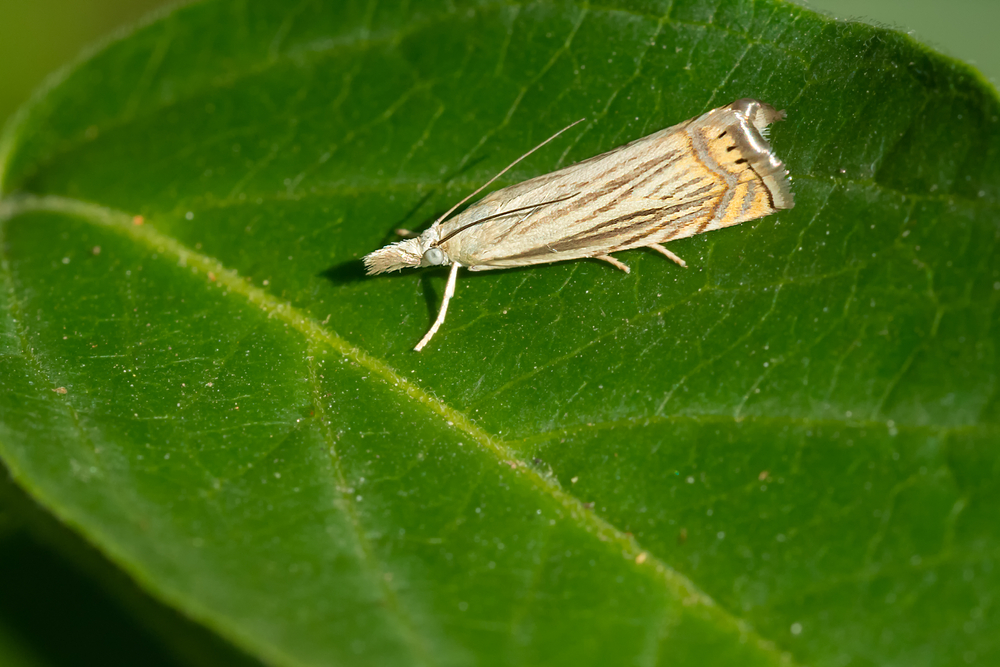
The adult tropical sod webworm, a small beige moth with a wingspan of 3/4 inch, initiates lawn damage. Known as a lawn moth or crambus, the female lays up to 200 yellow eggs that turn brown as they mature, typically in clusters of 10–35 on grass blades. These eggs hatch within 7–10 days into tiny juvenile caterpillars, about 1/2 inch long, that feed on the grass.
Full-grown caterpillars reach up to an inch in length and have four rows of dark spots on their abdomen. They live in individual burrows, emerging at night to feed, and can have up to five separate hatches annually.


What do sod webworms feed on?
Sod webworm larvae cause significant damage to turfgrass, primarily feeding on the blades of warm-season grasses like St. Augustine, centipede, zoysia, seashore paspalum, carpetgrass, bahia, and bermuda grass.
What are the signs of a sod webworm infestation?
The first sign of a sod webworm infestation is transparent grass blades, where juvenile caterpillars have skeletonized the blades, leaving only the vein structure. Mature caterpillars notch the blades and are mostly active at night, curling up in the thatch by day, often surrounded by moist, green fecal pellets called frass.
To detect an infestation, perform a soap flush: Mix 2 ounces of mild liquid dish detergent (like Lemon Joy, Ultra Dawn, or Ivory Clear) with 1 gallon of water. Pour this mixture within a 12-inch circle on the suspected area of your lawn. This can force the insects to the surface within five minutes, aiding identification.
For larger areas, use a diluted solution of two parts water to one part detergent to avoid turf damage. Typically, damaged turfgrass turns brown or straw-yellow, which can lead to increased weed growth as the grass canopy weakens.


How do I prevent and treat sod webworms?
Non-Chemical Control (Cultural Practices)
Healthy turfgrass is less susceptible to pests and recovers faster from damage. To help control sod webworms, consider these practices:
- Mowing Height: Maintain the correct mowing height for your turf type. Mow St. Augustine lawns at 2–4 inches and zoysia at 0.5–2 inches, ensuring not to cut more than 1/3 of the blade at once.
- Reduce Thatch: Proper mowing height and frequency can prevent thatch buildup.
- Watering: Limit watering to about one inch per week, including rainfall.
- Lighting: Turn off floodlights at night to avoid attracting moths.